
How Cistanche Help With Reducing Or Slowing There Rate Of Ckd Ⅱ
Mar 20, 2023
2.2. Comparison of the Chinese medicine symptom scores
Before treatment, there was no difference between the two groups (P> 0.05). After treatment, the TCM syndrome points values of patients in the control group were significantly lower (P < 0.05) at the end of 12 weeks of treatment compared with those before treatment; the TCM syndrome points values of patients in the treatment group were significantly lower (P < 0.05 or P < 0.01) at the end of 4, 8 and 12 weeks of treatment compared with those before treatment. The decrease in the TCM symptoms at the end of 4, 8 and 12 weeks of treatment was statistically significant in the treatment group compared with the control group (P < 0.01, Table 3).

Click Here To Get More Info About How Cistanche Capsules For Treating Kidney Disease
Ask for more:
Email:wallence.suen@wecistanche.com Whatsapp +86 15292862950

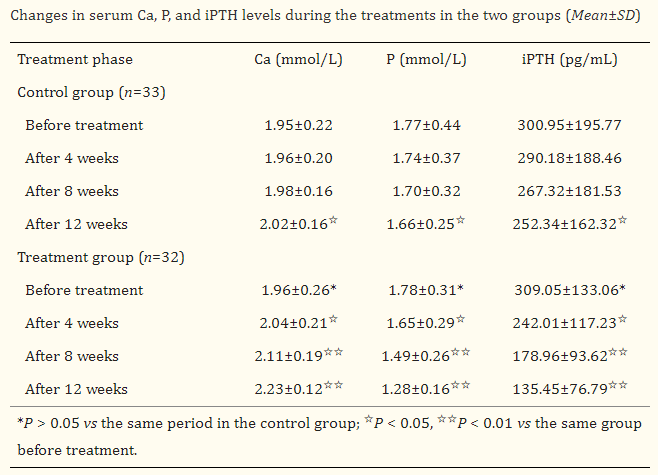
2.3. Comparison of changes in serum Ca, P and iPTH
Before treatment, there was no significant difference in serum Ca, P and iPTH between the control group and the treated patients (P>0.05). After treatment, serum Ca, P and iPTH were significantly increased and serum P and iPTH were significantly decreased in the control group at the end of 12 weeks of treatment compared with those before treatment, and the differences were statistically significant (P < 0.05), The differences were statistically significant (P < 0.05 or P < 0.01, Table 4).
2.4. Comparison of the changes of serum FGF23, FGFRs and Klotho protein levels
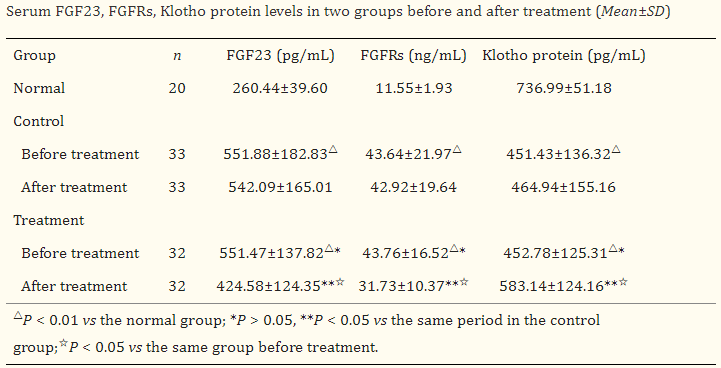
The levels of serum FGF23 and FGFRs were significantly higher in the control group and treatment group before treatment compared with the normal group (P < 0.01), and the levels of serum Klotho protein were significantly lower in the control group compared with the normal group (P < 0.01); the differences were not statistically significant between the levels of serum FGF23, FGFRs and Klotho protein in the control group and treatment group before treatment ( P>0.05).
There was no significant difference between the serum FGF23, FGFRs and Klotho protein levels in the control group and the treatment group after treatment (P>0.05). In the treatment group, serum FGF23 and FGFRs levels were significantly lower (P < 0.05) and serum Klotho protein levels were significantly higher (P < 0.05). In the treatment group, serum FGF23 and FGFRs levels were significantly lower and serum Klotho protein levels were significantly higher compared with the control group, and the differences were statistically significant (P < 0.05, Table 5).
3. Discussion
The name of CKD-MBD has no corresponding description in Chinese medicine, because the disease is mainly manifested by bone pain, fracture, pruritus, and oligomyelia [13], and it belongs to the category of "bone impotence" and "bone paralysis" in Chinese medicine. According to the book "Nei Jing: Su Wen", "the kidney is the master of bone and produces marrow" and "the kidney is full in the bone", the strength and fragility of the bone is an important sign of the strength and weakness of the essence in the kidney. When the kidney is full of essence, the bone marrow has a source of biochemistry, the bone is nourished by the marrow, the bone mineral content is normal and the bone is strong and powerful. When the human body ages, the kidney qi decreases, the kidney essence is deficient, the bone marrow is not enough to nourish the bones and the bone marrow is empty, which leads to the occurrence of bone diseases. It is believed that the basic pathogenesis is the deficiency of kidney qi. Since the patient's condition is persistent, with stasis, dampness and toxicity, the basic treatment is to benefit the kidney and detoxify the toxin, and to remove stasis and drain turbidity.

It is composed of Cistanches, Rhizoma Polygonati, Rhizoma Polygonati, Radix et Rhizoma Niubizum, Dandelion, Junxue, Ginger and Bamboo Roo, Poria, Peach kernel and Licorice. In this formula, raw rhubarb and dandelion have the effect of clearing heat and detoxifying, laxing and attacking accumulation; cistanche and cow knees have the function of tonifying liver and kidney, clearing menstruation and removing stasis; June snow clears heat and dampness, ginger and bamboo rhizome clears heat and removes annoyance, poria strengthens the spleen and harmonizes the middle, peach kernel dispels stasis and creates new energy; licorice harmonizes all the herbs, together they can clear the toxicity of upper, middle and lower jiao, tonify the qi of spleen and kidney, dissolve blood stasis and dispel dampness, together they can benefit the kidney and detoxify, dissolve stasis and drain turbidity. The results of this study showed that the total effective rate of the treatment group was 68.75%, which was significantly better than that of the control group 39.39% (P < 0.05), and significantly improved the clinical symptoms and TCM syndrome points of the patients. It was found [14] that the gene expression level of bone morphogenetic protein 2 in rats was significantly increased by the intervention of Cistanches aqueous extract, indicating that Cistanches can prevent osteoporosis to a certain extent. Modern research [15] showed that C. cistanche could improve the hypermetabolic state of renal tubules by inhibiting thylakoid cell proliferation, slowing down the occurrence of glomerular fibrosis and reducing the symptoms of uremia. The combination of rhubarb preparations and activated charcoal can help prevent hyperphosphatemia in dialysis patients [16].

CKD-MBD is one of the most common complications in patients with CKD, seriously affecting their quality of life and increasing mortality. The pathophysiological changes include decreased blood Ca, increased blood P, decreased active vitamin D, and increased iPTH, followed by disorders of calcium and phosphorus metabolism and secondary hyperparathyroidism (SHPT) [2]. The level of calcium and phosphorus metabolism in CKD-MBD patients has an important impact on the progression and prognosis of their disease [17-20]. The results of this study showed that the treatment group significantly increased serum Ca, decreased serum P and iPTH levels, increased Klotho protein, and decreased FGF23 and FGFRs levels, which was significantly better than the control group (P < 0.05). This suggests that Rong Huang granules can improve the calcium and phosphorus metabolism disorders and inhibit secondary hyperparathyroidism in non-dialysis CKD-MBD patients with kidney deficiency and damp heat, thus effectively preventing and treating CKD-MBD. In recent years, the FGF23-Klotho axis has been found to play a very important role in CKD-MBD [21-23]. Klotho protein is a co-receptor for FGF23, which has protective effects on the kidney, including anti-oxidative stress, anti-fibrosis, improvement of ectopic calcification of blood vessels and inhibition of inflammation [29-30]. FGF23, with the participation of Klotho protein, binds to FGFRs and activates downstream pathways, causing an increase in blood P and iPTH and a decrease in 1, 25(OH)2D3 levels, followed by disorders of calcium and phosphorus metabolism, SHPT, and vascular calcification, leading to the development of CKD-MBD.